
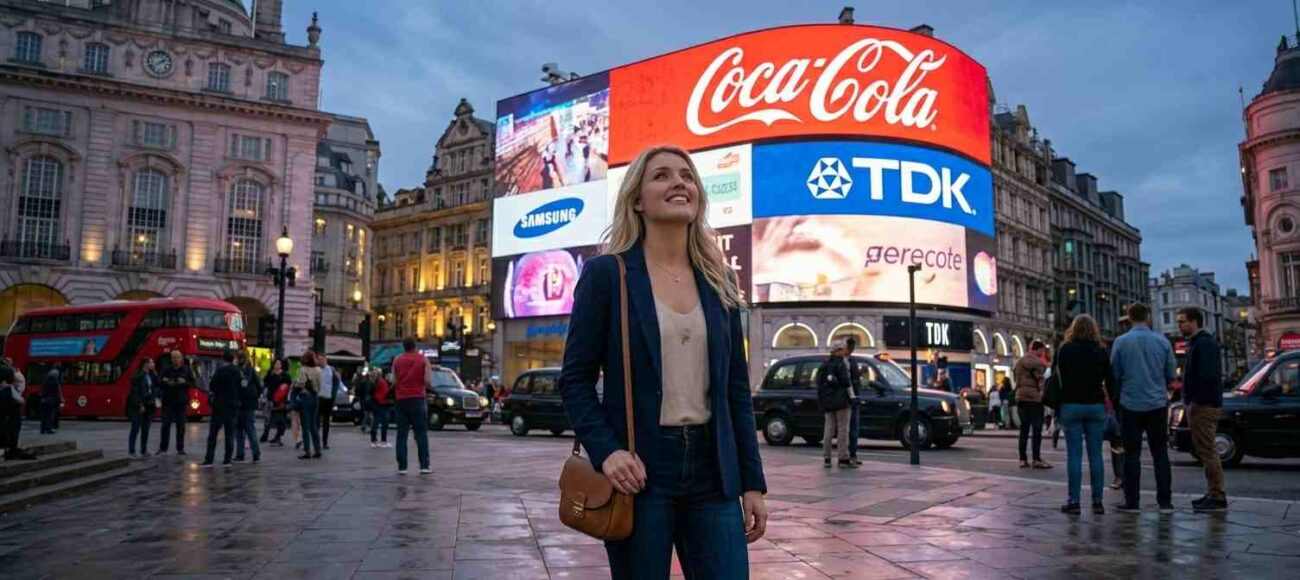
Paige Shiver Investigates Knightsbridge’s Most Fashionably Deceased Retail Apparition
Dear Diary,
I have it on excellent authority — specifically, on the authority of my friend Cordelia, who works on the fourth floor and once saw something move behind a mirror in the handbag department — that Harvey Nichols is haunted. Not in the vague atmospheric way that all Victorian buildings are slightly haunted. In the specific, definite way that involves a presence, a cold spot near the perfume counters, and an unexplained rustling near the sale rails that occurs even when there is no sale.
The Legend of the Harvey Nichols Apparition
Harvey Nichols has stood on Brompton Road since 1831, which is long enough to accumulate considerable spiritual residue. In that time it has sold fabric, food, fashion, and increasingly elaborate candles to generations of Knightsbridge residents who, one assumes, occasionally died before finishing their shopping. The question is not whether someone has died in proximity to Harvey Nichols. The question is whether they stayed.
London ghost lore is full of retail hauntings. The Time Out guide to haunted London catalogues dozens of spectral presences across the city, including several in the Kensington and Chelsea area. Harvey Nichols itself is not officially listed, but I think this is an oversight. If I had worked retail in 1870 and died unfulfilled on a mezzanine, I would absolutely stay.
What the Ghost Wants
I have a theory. The Harvey Nichols ghost, if it exists, wants a full refund. Not an exchange. Not a credit note. A full cash refund on something purchased in approximately 1903, for which the receipt has been lost but the emotional wound remains vivid. The perfume department cold spot supports this hypothesis. Cold spots near luxury goods suggest a presence that remembers the original price and considers the current equivalent deeply unfair.
Cordelia says the rustling near the sale rails is more ambiguous. It could be a ghost. It could also be a customer from Chelsea who arrives ninety minutes before the sale starts and refuses to make eye contact with staff. These phenomena can be difficult to distinguish.
Why Knightsbridge Is Perfect Ghost Territory
I have concluded that Knightsbridge produces such rich mythological material because it is a place where time does not move in the usual direction. The buildings are Victorian but the prices are science fiction. The residents are contemporary but their cultural references are Edwardian. You can walk from a flat that costs four million pounds to a museum containing things from 3000 BC in approximately seven minutes. That kind of temporal compression creates conditions in which the past refuses to stay where you put it.
The Historic Royal Palaces account of Kensington Palace — just a short walk from Harvey Nichols — lists multiple reported hauntings, including the ghost of George II. George II was not known for his pleasant personality in life, so his continued presence seems entirely consistent with character.
A Personal Retail Haunting
I should confess my own Harvey Nichols experience. Last February I went in to buy a birthday gift — something modest — and emerged two hours later with a perfume I did not need, a lipstick I had been specifically trying to avoid, and no memory of the middle forty minutes. I had been in the beauty hall. The bill was considerable. I have no explanation for the temporal gap. Cordelia says this is not a haunting, it is just the beauty hall. She said it in a tone suggesting she did not entirely believe it either.
I am going back next Thursday. I am bringing Cordelia to the handbag department and we are going to stand in front of that mirror. If something moves, I am going to say “full refund” and see what happens.
Yours, Paige Shiver
More satire at theonion.com.
The Broader Question of London Retail Ghosts
I have been keeping a list. Liberty, on Regent Street, feels haunted: the building was constructed with timber from old warships, and ships have their own mythology of spectral presence. Selfridges has a quality in the basement food hall that I cannot fully explain. Fortnum and Mason vibrates at a frequency slightly below standard reality, particularly near the teas.
What these shops have in common with Harvey Nichols is the quality of human desire concentrated in a single space over a very long period of time. People have wanted things in these buildings. They have wanted things they could not afford, things they could not justify, things already sold in the size they needed. That accumulated wanting leaves a residue. It accumulates in the changing rooms and behind the mirrors and near the sale rails. It becomes, over time, something that behaves like a ghost even if it is not one in the technical supernatural sense.
Cordelia says I am overthinking it. She may be right. But she admitted, when pressed, that she never feels entirely alone in the handbag department, and that is good enough for me.
The legend, in short, is in the mezzanine. And unlike the sale, it never ends.
SOURCE: https://bohiney.com/
