
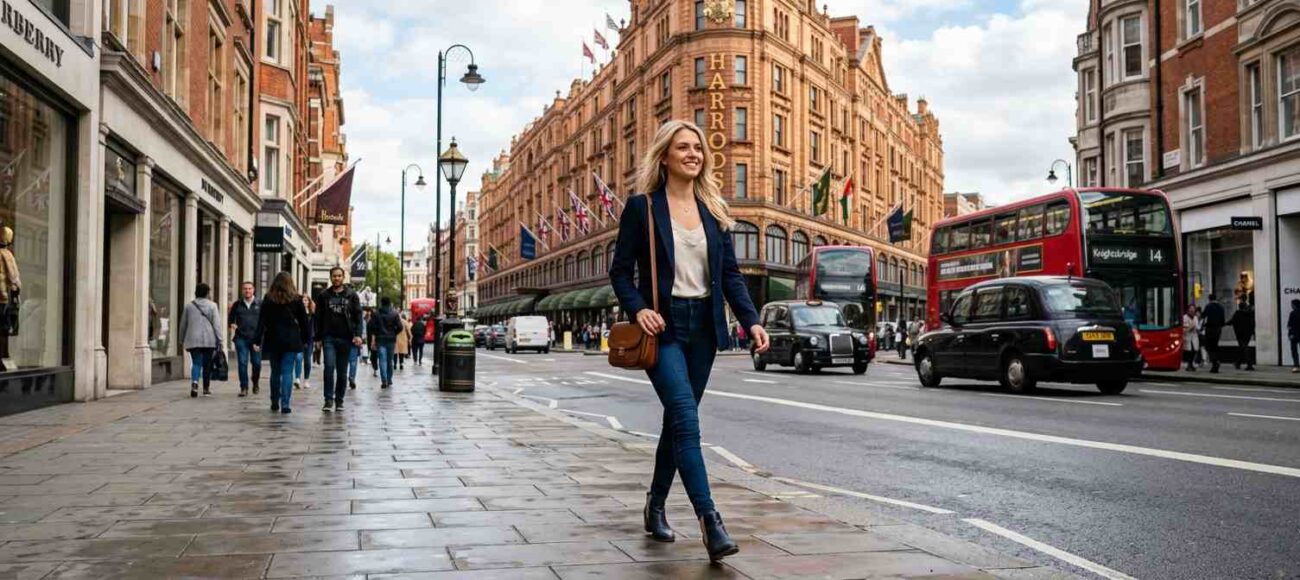
A Theological Crisis Unfolds Beneath the Memorial to Dodi and Diana on the Brompton Road
Dear Diary,
I need to tell you about the Egyptian escalators at Harrods, because I went back on Tuesday and something is different. The gods are restless. The enormous golden figures lining the Egyptian escalator hall — the sphinxes, the pharaoh heads, the hieroglyphic panels — have always had an air of patient power about them, but on Tuesday there was something additional. A quality that said: we have been here for several decades, we watched this extraordinary monument being built around us, and we are starting to form opinions.
The Egyptian Hall: A Brief Theological History
The Harrods Egyptian escalator hall was installed in the 1980s and is, objectively, one of the most astonishing retail environments in the world. It is a full commitment to the aesthetic of ancient Egypt transplanted into a Knightsbridge department store, complete with gold columns, painted hieroglyphs, and the kind of ambient grandeur that makes you feel you should be bringing tribute rather than looking for kitchen equipment.
At the base of the escalators sits the memorial to Dodi Al Fayed and Diana, Princess of Wales, which includes photographs and a wine glass from their final dinner. The juxtaposition — ancient Egyptian mythology, modern tragedy, and the fact that you can then ride the escalator up to the food hall for a Scotch egg — is so specifically Harrods that no other location on earth could produce it. The Harrods official history confirms the escalator hall as one of the store’s defining features, though it stops short of commenting on the theological implications.
What the Gods Are Actually There For
Here is my theory. The Egyptian gods were installed not as decoration but as guardians. Not of Harrods specifically — the store has security for that — but of something larger. The idea of Knightsbridge. The belief system that holds that this postcode, these streets, this particular convergence of old money and new money and money that cannot be discussed in detail, is worth protecting.
Every culture that has produced great wealth has produced supernatural explanations for why that wealth belongs to the people who have it. The Egyptian gods of Harrods are doing what gods have always done: conferring legitimacy on the transaction. You are not just buying a cashmere jumper for four hundred and fifty pounds. You are participating in a sacred economy endorsed by Anubis. This should be disclosed in the price tag.
The Diana and Dodi Dimension
The memorial at the base of the Egyptian escalators is one of the strangest monuments in London, which is saying something for a city that has sent its actual King to Washington on a diplomatic errand and called this normal. The memorial exists in a space between genuine grief and retail context that is not comfortable but is completely honest. It says: these people mattered here, and we are going to honour that without pretending the context away.
I stood in front of it for a long time. People stopped, looked at the photographs, and then got on the escalator to buy shoes. I found this more moving than I expected. Life continues. The gods watch. The shoes are purchased. This is, in its way, a complete mythology.
What I Think the Gods Want
The English Heritage pages on ancient Britain document the long history of sacred commerce in British life — fairs, markets, and holy sites were regularly the same location. Harrods is not an anomaly. It is the continuation of an extraordinarily ancient tradition. On Tuesday, as I said, something felt different. A quality of attention in the hall. The figures lining the walls paying careful consideration to what was happening at the bottom of the escalators. Perhaps thirty-four pounds for a bar of Harrods chocolate has finally pushed divine patience to its limit. Perhaps I need to eat lunch before I go shopping. All I know is that Knightsbridge contains more mythology per square foot than anywhere else in London, and the gods of the Egyptian escalator hall are getting their money’s worth.
Yours, Paige Shiver
More satire at private-eye.co.uk.
A Note on Retail Theology More Broadly
I want to be clear that I do not think Harrods is unique in this. I think all great department stores are, to some extent, temples. The architecture says so: the vaulted ceilings, the central atriums, the quality of light designed to fall on objects in a way that makes them look more significant than they would under ordinary illumination. Every great department store is making a theological argument. It is saying: the things in here matter. They have been selected and displayed with care and reverence. To acquire one is to participate in something that exceeds the merely commercial.
Harrods, with its Egyptian gods and its memorial and its thirty-four-pound chocolate bar, simply makes this argument more explicitly than most. The gods are visible. The sacred objects are lit from below. The tribute is itemised on your receipt. It is, in its way, the most honest retail experience in London. And I cannot stop going back.
SOURCE: https://bohiney.com/
