
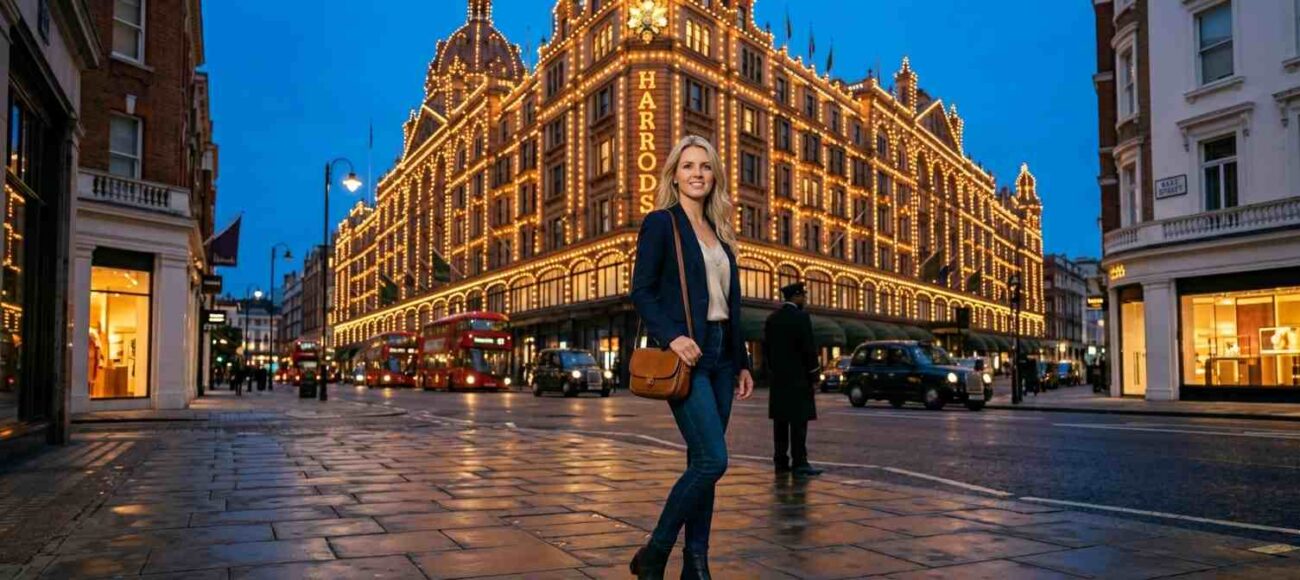
Black Shuck Comes to SW1X: Britain’s Most Ancient Legend Relocates for Economic Reasons
Dear Diary,
I have been reliably informed by my neighbour Gerald — who is not usually given to this kind of thing — that a large black dog was seen on Brompton Road last Thursday evening. Not unusual in itself: Knightsbridge is thick with large dogs, most attached to people who describe themselves as working in “asset management” and mean it literally. But Gerald says this dog was different. It had no owner. It left no footprints. It looked at him with eyes that contained an unusual quality of understanding, and then walked directly through a garden gate without opening it.
Black Shuck: Britain’s Most Persistent Supernatural Canine
For those unfamiliar with British folklore, Black Shuck is the spectral black dog of East Anglia — a creature reported for centuries across Norfolk and Suffolk, said to appear as an omen of death or misfortune, to haunt lonely roads and churchyards, and to leave behind a sulphurous smell and lasting existential dread. It is, to be clear, a regional legend. East Anglia. Not Knightsbridge. The postcode difference alone should disqualify it.
And yet. The English Heritage documentation of black dog legends notes that similar spectral canine traditions exist across the entire country under different names: Barguest in Yorkshire, Gwyllgi in Wales, the Wisht Hounds of Dartmoor. Britain is extensively haunted by large supernatural dogs, and there is no particular reason why one could not have relocated to London for economic reasons, like everyone else.
The Knightsbridge Adaptation
I have been thinking about what a Knightsbridge Black Shuck would look like. The original legend involves a creature of darkness appearing on desolate paths to terrify solitary travellers. Knightsbridge does not have desolate paths. It has Brompton Road, which has a Waitrose, a Dior boutique, and excellent pedestrian lighting. Any spectral presence operating here would need to adapt.
Gerald’s description — the Barbour jacket was his addition, not mine, but I find it extremely plausible — suggests an entity that has done exactly this. A supernatural dog that has observed its environment and made appropriate wardrobe decisions is a smarter supernatural dog than the folklore gives it credit for. The East Anglian version haunts lonely roads. The Knightsbridge version haunts garden squares and walks through locked gates that very good security systems nonetheless fail to detect.
What the Omen Might Mean
Traditional Black Shuck appearances portend death or disaster. I am not committing to that interpretation for the Knightsbridge variant, partly because Gerald, despite his encounter, seems fine. He did mention that his sourdough starter died the following day, which he considers significant, but I feel this is within the normal range of sourdough mortality.
The Museum of London’s folklore pages document various London supernatural traditions, noting that the city has always absorbed and adapted superstitions from across Britain. London takes its myths the way it takes everything else: from wherever they originate, strips out the regional specificity, adds a property valuation, and calls it local character.
Gerald’s Ongoing Relationship With the Legend
Gerald has become, since Thursday, a local authority on the subject. He has printed out a Wikipedia page on Black Shuck, which he keeps in his coat pocket. He mentions the gate incident at every opportunity. His wife Penelope told me privately that she considers it the most interesting thing Gerald has done in several years and that she is cautiously supportive of his continued involvement with the myth.
I think this is the correct response. London mythology requires participants. The legends of this city do not maintain themselves — they require the Geralds of the world, the people who see something they cannot explain and decide, against all available scepticism, to believe it and tell everyone about it. The dog, whatever it was, is probably still out there. I recommend keeping your sourdough starter warm.
Yours, Paige Shiver
More satire at waterfordwhispersnews.com.
The Broader Black Dog Tradition in London
What I find interesting, reading around the subject since the encounter on Brompton Road, is that London has its own black dog tradition, separate from Black Shuck. The black dog of Newgate Prison was said to appear before executions, having originated from a scholar killed and eaten by fellow prisoners during a famine in 1596 — which is both absolutely terrible and exactly the kind of story that produces a durable supernatural tradition. The Newgate dog was reportedly seen on multiple occasions over the following centuries, each appearance preceding a hanging.
Newgate Prison is gone. The Old Bailey stands in its place. I sometimes wonder whether the dog transferred with the function — whether the black dog that haunts sites of justice and consequence in London simply relocates as the institutions relocate, following the trail of human accountability through the centuries. If so, and if accountability has broadly dispersed across the city in a way that makes it harder to locate in any one spot, perhaps the dog has dispersed too. Perhaps Knightsbridge is now as close as consequence gets to anything.
Keep your gates locked. It will not help.
SOURCE: https://bohiney.com/
